

Do you know that how good you are at Bubble Shooter and how often you clear a level or get crushed by the ceiling highly depends on how well you understand the board before you shoot? Most players just aim and fire. They panic when the bubbles drop low. They waste their special bubbles on random shots. And then they wonder why they can never beat level 15.
So today I will give you a full breakdown of Bubble Shooter Java Game. Not just what the buttons do. I will teach you how to read the board, how to set up massive combos, how to use wall bounces to hit impossible angles, and how to stay calm when the ceiling is breathing down your neck. This is the guide I wish I had when I first started. Let’s get started.
Quick Game Info Table
| Detail | Info |
|---|---|
| Genre | Puzzle / Arcade Shooter |
| Developer | Various (Java mobile ports) |
| Platform | Java-enabled mobile phones |
| Release Era | Mid-2000s |
| Game Modes | Arcade, Puzzle, Time Attack |
| Controls | Numeric keypad (2, 4, 5, 6, 8) |
| Goal | Clear all bubbles before they reach the bottom |
What Is Bubble Shooter Java Game
Bubble Shooter Java Game is a mobile puzzle shooter where you control a cannon at the bottom of the screen. Bubbles of different colors hang from the top. You shoot colored bubbles upward. If your bubble touches two or more bubbles of the same color, they pop and disappear. If you pop bubbles that were holding up other bubbles below them, those hanging bubbles drop too. That is called a drop combo, and it is where the big scores live.
The catch? After every few shots you make, the entire ceiling of bubbles drops down by one row. If any bubble touches the bottom of the screen, the game is over. So you are not just popping bubbles. You are racing the ceiling.
History and Background
The bubble shooter genre started with games like Puzzle Bobble in the 1990s. When Java mobile games exploded in the mid-2000s, every phone brand wanted puzzle games that worked on small screens with simple controls. Bubble Shooter was a perfect fit. It did not need fancy graphics. It needed good color contrast, smooth aiming, and satisfying pops.
The Java version stood out because it ran on almost every phone. You did not need a smartphone. You did not need a touchscreen. Just your numeric keypad and some patience. It became the game you played on the bus, during lunch break, or when your teacher was not looking. It was simple to learn but hard to master, which is exactly why people kept coming back.
Key Features Breakdown
Graphics and Style: Bright, clean colors on a dark or simple background. Each bubble color is easy to tell apart even on old phone screens. The cannon is usually a small arrow or bubble launcher at the bottom center.
Sound Effects: Satisfying pop sounds when bubbles burst. A warning sound or visual cue when the ceiling is about to drop. Simple background music that does not distract you from thinking.
Game Modes: Arcade mode for endless play. Puzzle mode for level-based challenges with set bubble layouts. Time attack mode for score chasers who want pressure.
Level Progression: In puzzle mode, levels get harder by adding more colors, stranger wall layouts, and faster ceiling drops. There is no hand-holding after level 5. You either adapt or you lose.
Special Bubbles: Bomb bubbles that destroy everything around them. Rainbow bubbles that match any color. Iron bubbles that need multiple hits to break.
Game Modes Explained
Arcade Mode: This is the classic endless experience. Bubbles keep coming. The ceiling drops at a steady pace. Your goal is simply to survive as long as possible and score as high as you can. There is no level complete screen. Just you versus the bubbles until you slip up.
Puzzle Mode: Each level has a specific bubble layout. You must clear every bubble to win. The ceiling does not drop on a timer here. It drops after a set number of shots you take. So you have a limited number of moves to solve the puzzle. This mode teaches you precision.
Time Attack Mode: You have a countdown timer. Every bubble you pop adds a few seconds back. Every miss wastes precious time. This mode forces you to shoot fast but also shoot smart. Panic shots will end your run quickly.
GAME SCREENSHOTS
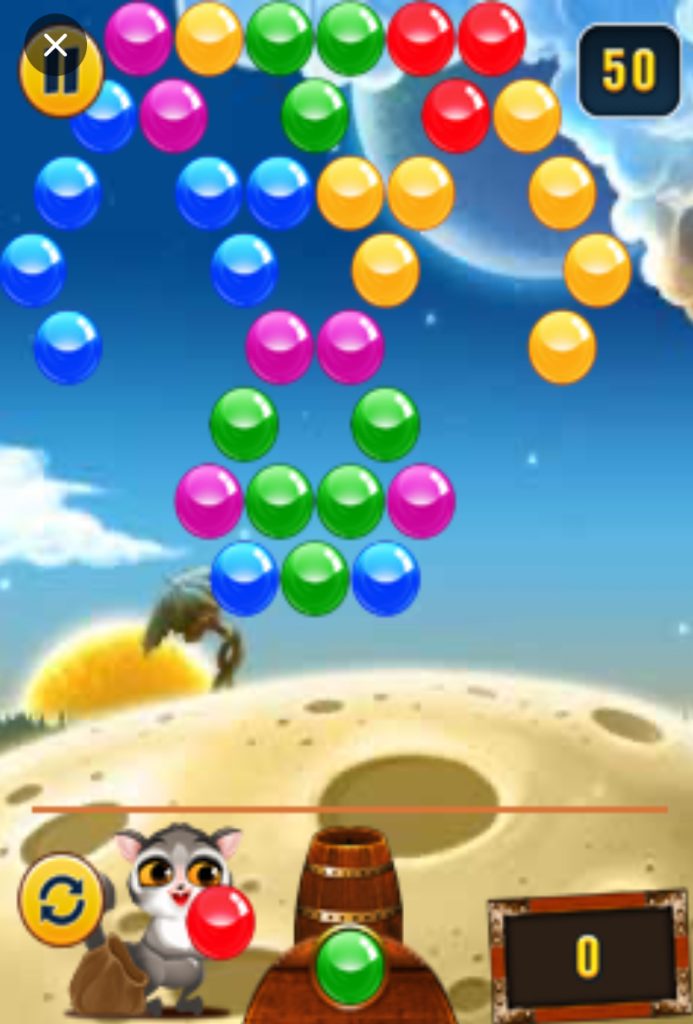
How to Play: Step by Step with Exact Button Presses
Launching and Getting Started
When you open the game, you will see the main menu. Use the 2 and 8 keys to move your selection up and down. Press 5 to confirm your choice. Select “New Game” or the mode you want. Press 5 again to start.
Aiming Your Bubble
Your cannon is at the bottom. A dotted line or arrow shows where your bubble will go. Press 4 to aim left. Press 6 to aim right. Press 2 to aim higher. Press 8 to aim lower. Small taps of 4 or 6 give you fine control. Hold them down and your aim swings fast. I usually tap 4 three times, check my line, then tap 6 once to correct it.
Shooting
Once your aim is set, press 5 to shoot the bubble. The bubble travels in a straight line until it hits a wall or another bubble. If it hits a wall, it bounces. If it hits bubbles, it sticks.
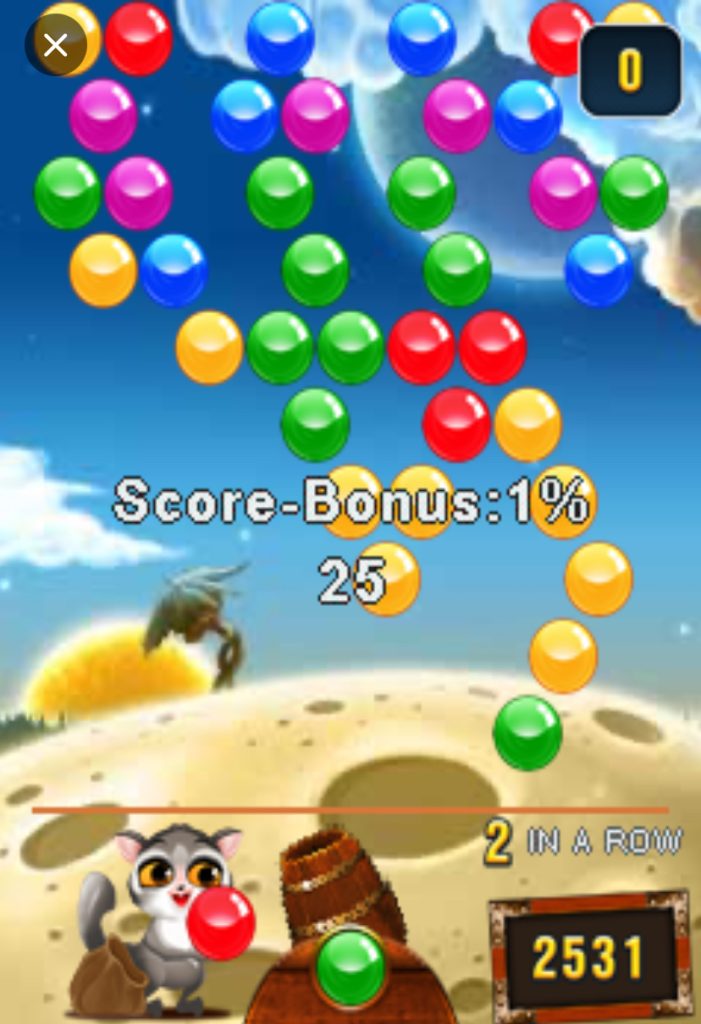
Swapping Bubbles
Most versions let you see your next bubble in a small preview box. Some versions let you swap your current bubble with the next one. If your game has this feature, press the star key * to swap. This is huge. If your current bubble is blue and there are no blue bubbles to hit, but your next bubble is red and there is a red cluster waiting, press * to swap, then press 5 to shoot the red one.
Wall Bounces
This is where the magic happens. Sometimes a bubble cluster is tucked behind others and you cannot hit it with a straight shot. Aim at the left wall or right wall instead. Press 4 or 6 until your aim line points at the wall at a sharp angle. Press 5 to shoot. The bubble bounces off the wall and angles down into the cluster.
Here is a real example from my play. I was on level 8. There was a group of three yellow bubbles hidden behind a wall of green ones. No straight shot could reach them. I pressed 4 four times to aim at the left wall. The dotted line showed the bounce path curving right toward the yellow cluster. I pressed 5. The bubble bounced perfectly, hit the yellow cluster, and popped them. The green wall above them had nothing to hold it up, so ten bubbles dropped in a massive combo. My score jumped by thousands.
Reacting to the Ceiling Drop
Every few shots, the ceiling drops. You will hear a sound or see the bubbles shake. When this happens, do not panic shoot. Press 2 quickly to raise your aim and check if any bubble is now dangerously low. If a color near the bottom matches your current bubble, press 4 or 6 to aim at it and press 5 to clear it before the next drop. If nothing matches, press * to check your next bubble. If that matches, swap and shoot.
Pausing and Checking Score
Press the right soft key or 0 to pause the game. This stops the action and lets you breathe. Check your score, plan your next three shots, then press 5 to resume.
Power Ups and Special Bubbles
Bomb Bubbles: These look like bubbles with a fire or explosion symbol inside. When you shoot a bomb bubble into a cluster, it explodes and destroys every bubble in a small radius around it, regardless of color. Do not waste these on a cluster you could clear with a normal shot. Save them for when bubbles are packed tight and you need to create breathing room.
Rainbow Bubbles: These are multicolored or sparkling bubbles. They match any color they touch. If you have a rainbow bubble and you see a cluster of two red bubbles, shoot the rainbow at them. It counts as red and pops the cluster. I once had a rainbow bubble and a board full of scattered colors. I aimed at a single blue bubble using 6 twice, pressed 5, and the rainbow matched it. That popped the blue cluster, which caused a chain drop of fourteen bubbles.
Iron Bubbles: These are gray or metallic bubbles. They do not pop with color matches. They need to be hit by a bomb bubble or dropped by clearing the bubbles above them. Do not waste normal shots trying to break them.
Multiplier Bubbles: Some versions have bubbles with numbers or star symbols. Popping these doubles or triples the points for that shot. Try to set up drop combos that include these bubbles for massive score spikes.
Scoring System and How to Maximize Points
Every bubble you pop with a direct shot gives you base points. But drop combos are where the real money is. When you pop bubbles that were supporting other bubbles below, those unsupported bubbles fall. Each dropped bubble gives you points too, and the more bubbles drop at once, the higher the multiplier.
Here is the trick. Do not clear bubbles randomly. Look for bubbles that are holding up large sections of the board. If you can pop the one small cluster keeping thirty bubbles alive, those thirty drop and your score explodes.
On level 12, I noticed a single red bubble holding up a huge pyramid of mixed colors. I had a red bubble ready. I pressed 4 twice, then 2 once to adjust the angle, and pressed 5. The red bubble hit its target. Thirty-two bubbles dropped in one combo. My score went from 12,000 to 28,000 in one shot.
Level Design and Progression
The first three levels are gentle. The bubble colors are limited to three. The ceiling drops slowly. The layouts are wide open. Levels 4 to 8 introduce a fourth color and tighter clusters. You start needing wall bounces to reach hidden bubbles.
Levels 9 to 15 are where it gets real. Five colors appear. The ceiling drops faster. Some levels have wall blocks that force your bounces into weird angles. You cannot just react anymore. You have to plan two or three shots ahead.
If the game has boss levels or special challenge levels, they usually appear every ten levels. These might have iron bubbles mixed in, or a faster drop rate, or a requirement to clear within a certain number of shots.
Hidden Mechanics Most Players Miss
Aim Assist: The dotted line is not just cosmetic. It actually helps you predict where your bubble will stick. But it does not show bounces perfectly. You have to learn how the angle changes after a wall hit. Practice on early levels until you can predict bounces without the line.
Color Distribution: The game tries to give you colors that exist on the board. But it is not perfect. Sometimes you get three green bubbles in a row when there is only one green bubble left at the top. When this happens, use wall bounces to reach that last green bubble, or use a rainbow bubble if you have one. Do not just shoot green into a random spot and hope.
Ceiling Drop Timing: The ceiling does not drop after every shot. It drops after a set number of shots, usually six or eight depending on the level. Count your shots. If you know the drop is coming after your next shot, make sure that shot clears something important or creates space near the bottom.
Bubble Sticking Physics: When your bubble hits another bubble, it snaps to the nearest grid position. This means a shot that looks like it should squeeze between two bubbles might actually stick to one of them. Aim with a small margin of error. If the gap looks tight, use 4 or 6 to adjust slightly and test a different angle.
Beginner Mistakes to Avoid
Shooting Too Fast: I see this all the time. A new player sees a cluster, aims roughly, and mashes 5. The bubble misses, sticks in a bad spot, and now that color is buried. Slow down. Use 4 and 6 to fine tune. Press 2 or 8 if you need to adjust height. Then press 5.
Ignoring the Next Bubble Preview: That small box showing your next bubble is your lifeline. If your current bubble is useless but your next one is perfect, you might want to shoot the current one into a safe corner to get rid of it. Or press * to swap if your game allows it. Never shoot without checking what is coming next.
Wasting Special Bubbles: Using a bomb bubble to clear three normal bubbles is like using a fire extinguisher on a candle. Save bombs for emergencies. Save rainbow bubbles for colors that are hard to reach or almost gone.
Forgetting Wall Bounces: This is the biggest skill gap between beginners and good players. Beginners only shoot straight. Good players use walls to hit every angle on the board. If you are not using wall bounces by level 5, you will get stuck.
Panic Shooting When the Ceiling Drops Low: When bubbles get close to the bottom, your instinct is to shoot fast and clear anything. This usually makes it worse. You stick bubbles in bad spots and block your own future shots. Instead, pause with the right soft key or 0. Breathe. Look for one good shot that clears a cluster or drops a big section. One good shot is better than three panic shots.
Stacking in the Center: Beginners tend to shoot everything toward the middle of the board. This creates a tall wall in the center that is hard to break. Spread your shots to the sides when possible. Keep the center open for easy access to the whole board.
Advanced Strategy Tips
Building Bridges: Sometimes you need to connect a distant cluster to a closer one so they share a color path. Shoot a bubble that matches the distant cluster but lands next to a closer cluster of the same color. Now they are connected. Your next shot can pop the whole group.
Planning Drop Combos Two Moves Ahead: Do not just look for what you can pop now. Look for what will be exposed after you pop it. If popping a blue cluster will leave a red cluster hanging, make sure you have a red bubble ready for your next shot. I usually check my current bubble, my next bubble, and sometimes the one after that.
Managing Colors by Clearing One Completely: If you can pop every bubble of one color from the board, the game stops giving you that color. This makes your remaining shots easier because you have fewer colors to juggle. Prioritize clearing the rarest color first.
Safe Play vs Risky Shots: If the ceiling is high and you have time, take the risky shot that sets up a huge combo. If the ceiling is low and one drop away from disaster, take the safe shot that clears the bottom row even if the points are low. Survival first. Style second.
Reading the Board Before Every Shot: This sounds obvious but almost nobody does it. Before you press 5, scan the entire board. Where are the biggest clusters? What colors are trapped? Where is your next bubble actually useful? Five seconds of thinking saves you from a bad shot that costs you the level.
Comparison with a Game I Played
I also played a lot of Bust-A-Move on mobile back in the day. It is in the same bubble shooter genre and feels similar at first. But there are real differences.
Bubble Shooter Java Game is cleaner and faster. The controls with the numeric keypad feel precise. 4 and 6 for aiming, 5 for shooting, it becomes muscle memory. Bust-A-Move had cuter graphics and a story mode, but the aiming felt slower and the special bubbles were harder to use.
Where Bust-A-Move wins is variety. It has more bubble types, more characters, and more visual flair. But for pure puzzle satisfaction, Bubble Shooter Java Game is better. The level designs in Bubble Shooter force you to think about angles and bounces in a way Bust-A-Move does not. And because Bubble Shooter is simpler, you can play it in short bursts. A Bust-A-Move session feels like a commitment. A Bubble Shooter session feels like a quick win.
I keep coming back to Bubble Shooter because of the drop combos. That moment when you plan three shots ahead, execute them perfectly, and watch half the board fall while your score explodes. Bust-A-Move never gave me that same rush.
Conclusion
Bubble Shooter Java Game is not just about popping bubbles. It is about reading the board, planning your shots, and staying calm when the pressure rises. Use 4 and 6 to aim with precision. Use 5 to shoot with confidence. Use wall bounces to reach impossible angles. Save your special bubbles for the right moment. And always, always check your next bubble before you fire.
Practice these tips, avoid the beginner mistakes, and you will start clearing levels you used to lose. The ceiling will still drop. The colors will still mess with you. But now you know how to fight back. Get out there and pop some bubbles.

This game is good, I love your review.